
There are lots of different opinions on what causes Google to index a site or page. With a test on a new test subdomain on a brand new domain, I tried to bust a couple of these myths.(credits: SEOmoz)
1) Google indexes a website if you add a Google Analytics code. Busted!
Nope. The first thing I did, was adding Google Analytics to all pages on this subdomain. I even visited some of the pages with around ten different IPs. Even after a month, Google didn’t index the website.

2) Google indexes a website if you use Google AdWords. Busted!
The second thing I did, was opening a brand new Google AdWords account. By bidding on a few keywords (with low, lower and really, really low search volumes), I hoped to see if this could trigger Google to index the subdomain. I even visited some of the pages by clicking on a few ads with around five different IPs. Three weeks, the website still wasn’t indexed.

3) Google indexes a website if you add Google AdSense. Busted!
Unlike the previous tests, I already assumed that this one wouldn’t work. Adding AdSense and even clicking a few of the ads (don’t worry, it were PSAs) didn’t manage to get the subdomain indexed.

4) Google indexes a page that can only be reached through nofollow links. Busted!
As you can see on the first page of the test subdomain, one of the links is being nofollowed. Like Matt mentioned a few times, Google shouldn’t index nofollowed pages (accessible by nofollow links only) or give weight to nofollowed anchortext. After doing a site: query, I noticed that the page isn’t indexed. Google doesn’t even return the URL of the page. But here comes the weird part.

5) Google indexes a page that is excluded by robots.txt. Plausible!?!
I always thought that adding a noindex-meta tag to a page would mean about the same as excluding it with robots.txt. This, however, would mean that Google won’t show the page in it’s index. As you can see in the screenshot below, Google actually shows an excluded URL when you do a site: search.
I don’t care if it’s a frikkin’ supplemental page, you shouldn’t show this page if I explicitly tell you not to access the page!
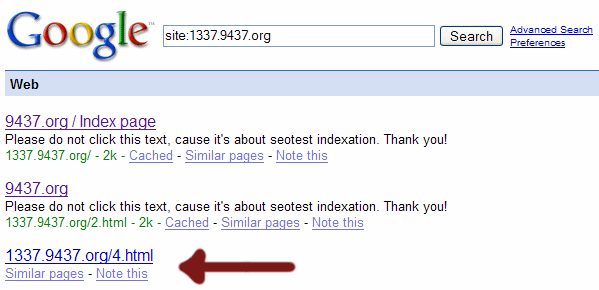
So if you don’t want Google to show a particular URL, I guess you’d better use nofollow in stead of robots.txt…

This was just part of a first test, I hope I will be able to publish some more results/ bust a few more myths soon. If you want to suggest an SEO myth, or if you have test design suggestions or other things, please leave a comment or send an email. Seriously, I’d appreciate it.

Oh, and the credits for the personification of Googlebot go to SEOmoz (like you didn’t know…).

14 Comments »

  1. Great post and nice busts :)

    I don’t completely agree on 5 though. As you can see, it doesn’t show a snippet. It DOES know, through your linkage, that the page is there. The proper way to really bust this one once and for all would be including a link to 5.html from the excluded 4.html, and only from there.

    Comment by Joost de Valk — August 8, 2007 @ 11:32 am

  2. [...] note: A fellow Dutch SEO, Wiep, has done a nice post busting some SEO myths, worth checking [...]

    Pingback by Busting some SEO myths - SEO Blog - Joost de Valk — August 8, 2007 @ 11:38 am

  3. @Joost: Thanks for the kind words. I guess you must have missed the link on page 4.html, which is pointing to page 3.html ;)

    Comment by Wiep — August 8, 2007 @ 11:57 am

  4. Next:

    Google indexes a page visited with the Google toolbar

    Comment by Jeroen — August 8, 2007 @ 4:36 pm

  5. @Jeroen: Hmmm, I guess that one is busted as well. Now you mention this, I think at least three of the six computers I used for the Analytics test had the Google Toolbar installed…
    I never believed this myth btw

    Comment by Wiep — August 8, 2007 @ 8:01 pm

  6. Hi Wiep,

    I’m a Japanese webmaster and happened to find your blog.
    Very interesting article!

    I completely agree with you on the first three.

    As to #4, I guess Google spider follows the link with rel=”nofollow”, but does not index it.
    Am I right?

    As to #5, we can’t trust robots.txt if your opinion is the case.
    I hope your further invstigation.

    Thank you very much.

    Comment by Kenichi Suzuki — August 8, 2007 @ 10:21 pm

  7. Nice post Wiep !
    Very interesting…

    Comment by hamoedie — August 10, 2007 @ 3:50 pm

  8. [...] was reading Joost’s blog over the weekend and he was talking about Wiep’s post about Google SEO Mythbusting and I could not help but think about what my PhD supervisor used to give people grief [...]

    Pingback by » SEO Myths : UKGimp » Blog Archive — August 13, 2007 @ 12:59 pm

  9. [...] zijn post hier en kijk waarom ze niet kloppen. Stem op dit artikel of voeg het toe [...]

    Pingback by Foute SEO stellingen : SEO Handleiding » Zoekmachine Optimalisatie — August 13, 2007 @ 8:05 pm

  10. Top SEO Myths…

    If you’re new here, you may want to subscribe to my RSS feed. Thanks for visiting!Will Google give you preferential treatment if you sign up for Adwords? Will you get spidered and indexed faster?
    What about nofollow tags? Are they often ignored?  He…

    Trackback by SEO Blog — January 28, 2008 @ 12:34 am

  11. [...] Recentemente, um blog de fora do Brasil fez um teste sobre o que eles chamara de mitos do google: Busting Google indexation myths. [...]

    Pingback by Google Index: Mitos e Verdades — January 30, 2008 @ 11:41 am

  12. [...] Blogs Scary SEO Myth Number 5 The SEO Myth SEO Myths Three SEO Myths Debunked Busting Google Indexation Myths Are We Suffering from Pagerank Paranoia There are No Secrets and Other SEO [...]

    Pingback by 10 SEO Myths | Edmonds Commerce Blog — February 4, 2008 @ 2:46 pm

  13. I especially like the nofollow test, it reveales the true (lack of) value of this type of link.

    Comment by EDL flash & seo — March 8, 2008 @ 6:48 am

  14. Google will index a page and follow a nofollow as long as the page within wherte the link resides is an authority site..Great piece though..

    Comment by SEO update — May 11, 2008 @ 10:58 pm

RSS feed for comments on this post. TrackBack URL

Leave a comment


Posted in SEO by Wiep